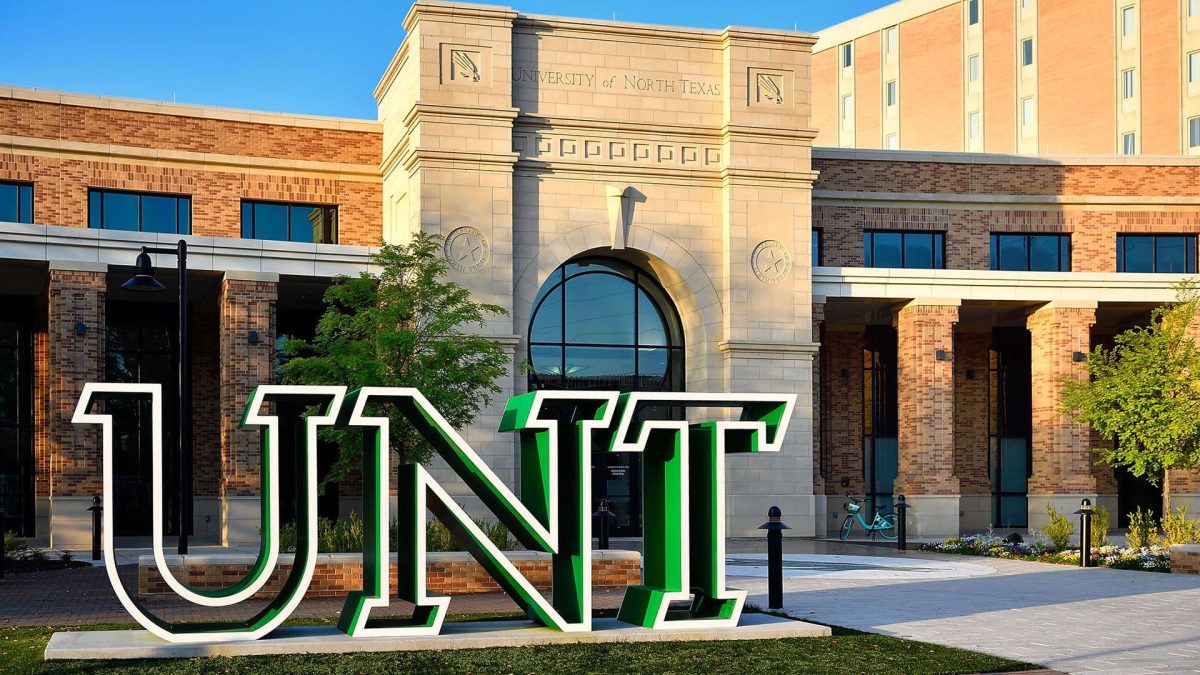
On March 19, University of North Texas President Harrison Keller announced the consolidation and/or removal of 85 programs and degrees, most of which are humanities and liberal arts, amid a $45 million budget deficit. The largest change is the merger of the Department of Linguistics and the Department of World Languages, Literatures and Cultures.
Declan Spencer, admitted to UNT for a bachelor’s in linguistics, said he found out about this change through an article a friend showed him.
He was “incensed” at the decision, as he would no longer be able to complete his degree as planned.
“I was on FaceTime with my friend, and they told me what happened,” Spencer said. “I thought it was a joke. I quickly realized it was not, and with the whole process, the lack of communication was really frustrating. It was all just in one email I never got.”
UNT students and faculty received a message from the president notifying them about the change. Jhania Goodar, a student from the UNT class of 2030, was surprised when she opened her inbox.
“I was very shocked when I saw the email,” Goodar said. “Because even though they didn’t include the minors or majors I was going to take, I do find [humanities] very important to understanding other people.”
Even students who don’t go to UNT were baffled for various reasons.
“I was a little bit confused at first because I know a lot of colleges are being more open towards helping with financial aid for a lot of students in more ways than they have before,” senior Elle Morlet said. “I didn’t really understand why they were choosing to cut what I believe to be very important programs in order to make college more affordable, when there are so many ways that don’t have to be straight from cutting programs.”
No new students will be able to enroll in these degrees. Spencer contacted the Department of Linguistics for guidance and inquired about the future of his major.
“All the people that I was in contact with did not seem to know what to do, even within the Department of Linguistics.” Spencer said. “ They advised me to just drop it. I was originally admitted for linguistics, with a double major in music education.”
Students feel that these cuts do more harm than good.
“They show that [the humanities] are in a decline,” Goodar said. “I used to think liberal arts was a very big thing, but over the years, I see a lot of them getting cut. I’m tired of all these biology majors, even though [I am one], that think they’re smarter than everyone, when in reality, we all just need to learn how to accept every human that’s on this earth. And schools are cutting out the classes that teach that.”
This announcement comes just months after Texas A&M cut its women’s and gender studies programs, during a time where many Texas universities have been pressured to limit teaching of gender, race, and sexuality. Senior Varunya Pongvaramitchai said she discovered what had happened through an Instagram post where the university faced backlash.
“When I applied, I knew that A&M was a primarily Christian school and that a lot of their higher ups hold [more traditional] beliefs,” Pongvaramitchai said. “But it is a little bit disappointing that they’re not keeping up with the current generation and changing education as the generation is changing.”
Students find that the educational downsizing from UNT and A&M, among others, has big implications on the state of education. Incoming students criticize UNT’s prioritization of money over education, and question the university’s focus on “time to value” for each major.
“It’s definitely become a lot about money versus education,” Spencer said. “I think that’s what’s gonna happen, no matter what, when education becomes a business that runs on optimization. I think we recently have seen a big rise in the recognition of liberal arts and humanities as valid sciences, but I think this [situation] is indicative of people’s drive to change that for whatever reason they may have.”
Even though she will not be majoring in any liberal arts, engineering major Zazil Berrios views them as an essential part of life.
“They’re a big part of our culture,” Berrios said. “Like, let’s say if someone is studying art. Art has been here for centuries, right? I am a big fan of the arts. It is a big part of who we’ve become, and if that stuff is being taken out, it’s like taking away part of our history, our culture.”
Students feel that the humanities shouldn’t be neglected for many reasons.
“I do think it’s very overlooked a lot of the time,” junior Camryn Dunn said. “Because it’s like ‘STEM makes you more money, blah, blah.’ And yeah, that might make you more money, but is that really what’s most important for the new generations?”
Sophomore Mason Johnson said liberal arts need to be studied in order to be knowledgeable about the world. He holds humanities over STEM fields, emphasizing the impact of liberal arts on areas like law and morality.
“They’re important because just understanding the world around you and how people are being affected in it is important,” Johnson said. “ I think that it’s more important not only to know things like math and science, but also to have empathy and have knowledge of how people are being affected and what people are going through.”
Due to these cuts, Spencer is concerned about the status of education and how many institutions disregard it.
“Education, beyond just teaching everyone, equips those who have no other avenues to fight back with the power to do so,” Spencer said. “Education is power. And when education is defunded, it strips away people’s ability to advocate for themselves and for others.”